Showing posts with label Russia. Show all posts

Friday, 25 October 2013

London life: Debate, discussion and misunderstanding

The heavens are caressing London with  golden light and the trees in Hyde Park bring out their golden robes in return.
All is well in this the greatest and freest city on earth!


It is Elena's birthday. To celebrate we go the The Landmark Hotel on the Marylebone Road for afternoon tea: me, Elena, her Mum and one of her sons and his girlfriend. A happy and harmless crew.
The solicitous doorman is kind and considerate as he shows us how to get the wheelchair conveying Elena's Mum into the cafe.
We are seated in the voluptuous setting of the atrium cafe and champagne is served.
Elena's Mum is beaming with happiness, pride and joy.


But alas - it is fearfully expensive. I ask the waiter if we can buy just one afternoon tea and share it. We are not very hungry. The waiter must ask the manager. No, we must buy three. This would amount to £126. Surely, I persist, since the cafe is virtually empty, and we are drinking the champagne (not cheap either - at £76!), you can bend the rule for once. The manager appears and firmly insists that the rule cannot be broached. If we consume less than three afternoon teas, we will have to sit in another part of the hotel. This would mean us reseating Baboushka in her wheelchair and going up to another floor.
We decline, amazed by the lack of initiative allowed The Landmark workforce. I was tempted to ask if I would have to ask the manager if I could use the lavatory.

Still, it was a pleasure only partly spoilt, and we walked across to The Frontline Club in Paddington (The Journalists Club) to listen to a discussion about the future of Russia and the fate of the oligarch Khodorkovsky.

The former British ambassador to Russia Sir Tony Brenton thought that things were getting better and that the rule of law will one day prevail in Russia, whereas it is perhaps a little patchy now.
We should welcome their money, he said, and that will be good for us and for Russia.
Other speakers disagreed. The money is tainted and our taking it discredits us.

Later, we are dining in the restaurant below, discussing this issue.
I take the view that it is a matter of balance, but to illustrate my point, say that we should not have wanted to trade with Hitler's Germany if the conditions were that we were not allowed to trade with Jewish people, or with Stalin's Russia if we were forced to trade with companies that employed Gulag labour.

Suddenly, a woman sitting at the table next to us leaned across.

" I would be very careful if I were you" she said, and continued, " I'm jewish, and I heard what you said"

Now of course, she only heard half of what I had said.

But that's how wars start, isn't it?

Somewhat dismayed, because she persisted in threatening me, we left.

Ah well, nowhere is perfect.


Monday, 21 January 2013

Strange connections : Gerard Depardieu, tax, patriotism and Mayakovsky


Gerard Depardieu is a badly behaved actor.

He has has been convicted of drinking and driving and is alleged to have assaulted somebody that he crashed his scooter into.

On an aeroplane, he appalled his fellow travellers by urinating in the aisle.

He is incontinent generally, it would seem, being unable to control his appetites.

Our writing this will not offend him in the slightest - he is the sort of person who doesn’t care what anyone thinks, which is probably just as well.

Now we don’t really care much about him either, but we were struck by the claim that M. Depardieu made, during his dispute with his own government over taxation, that he is a creative person.
And since he is now a Russian citizen, and has been welcomed personally, and endorsed as a model citizen, by President Putin, we thought it might be interesting to reflect on whether M. Depardieu’s legacy in Russia will match that of the great Russian poet Mayakovsky (1893 - 1930) - a man who really was creative.

Why make such a comparison at all?

Well, M. Depardiue deserves to be brought down a peg or two, so comparing his claim to creativity to someone whose claim is not in doubt seems to be a good place to start.
Secondly, M.Depardieu’s publicists call him ‘larger than life’ (a common euphemism for overweight actors) so perhaps the comparison will make him look like a pygmy, which can only be sobering for him, which in turn can only be good for his health.
Thirdly, Depardieu claims now to be a Russian patriot, and to regard the Russian people as beautiful and creative, although this compliment does not extend to the opposition, whom he regards as unpatriotic.

‘Judge not, that ye be not judged, for measure for measure shall ye be judged the same....’

I hope these reasons suffice, but there is a fourth, which is simply that we love Mayakovsky’s poetry and admire the way he lived.

M. Depardieu, his art or life, we do not.


M.Depardieu, like a lot of movie actors, just plays himself. And like a lot of movie actors who just play themselves, he has eventually become a parody of himself.

Mayakovsky, on the contrary, was a creative genius, who could write lines like this, which even in translation stir the soul :

You can forget
              when
              and where
you stuffed
               your craw
               and your belly,
                               but
the land
    you hungered with
        you can never
as long as you live and breathe
                     forget!

Mayakovsky knew something about patriotism that Depardieu will never learn.
Although the poet of the Bolsheviks, Mayakovsky, who worked hard for the revolution, and spent time in prison for his work for it before the revolution, became disillusioned with the turn towards authoritarianism and began to write satirically of the regime - a risky business.
He didn’t, though, run away to avoid paying his taxes, despite the fact that he was allowed to travel and did so widely.
He also had a strong, deep and resonant voice, strangely reminiscent of Tennyson reading The Charge of The Light Brigade - both great men, a generation and a continent apart, but conjoined by the art of poetry.


Mayakovsky has been memorialised by Russia in many ways - in Moscow, he has a museum and a theatre named after him and a Metro station dedicated to him.
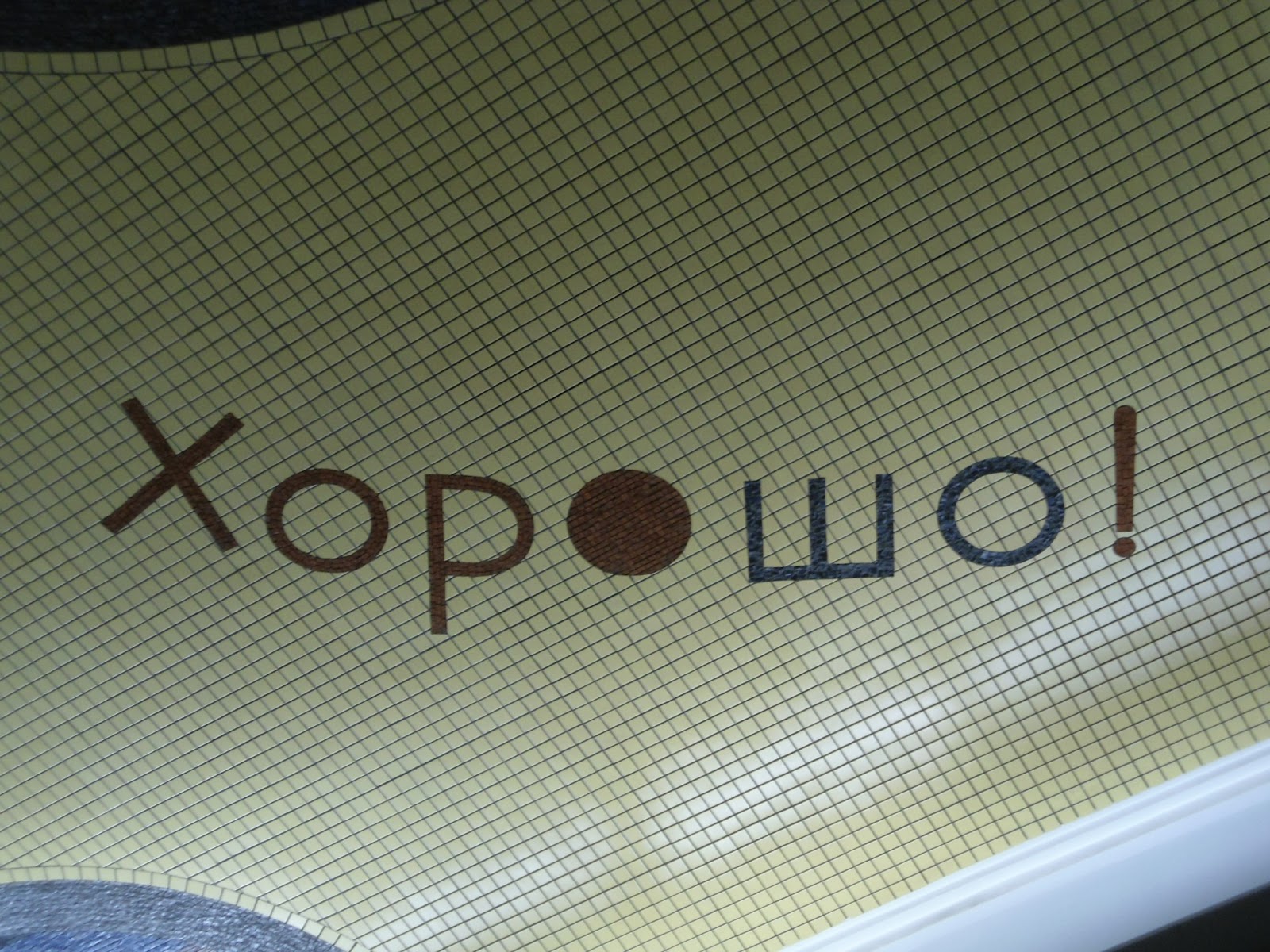
This station is magnificent, a palatial corridor runs between the main platforms and the ceilings are decorated by mosaic renditions, in the style of orthodoxy itself, of bolshevik iconography.
The entrance vestibule is equally splendid, a gently rising and arching dome decorated with lines and words from his most famous poems.


Here is a question for the Russian Government of today : imagine that you need to increase the level of taxation from its current level of 13% to cover some emergency - perhaps another currency crisis, or the return of the oil price to $25 a barrel. Do you then imagine that M. Depardieu will still be a Russian patriot and stick around to share the pain?

He hasn’t got the bladder for it.

The only memorial he is likely to have erected is a temporary public lavatory.

Last year, Russians took $560 billion out of the country - it's called Capital Flight, and it's serious.

What do they know that M. Depardieu does not?

Oliver Wendell-Holmes, the great American jurist, said ' Tax is the price you pay for civilisation'

Russia is almost alone in having a flat rate of tax which is not only very low but does not graduate at all as income increases.

This is a right wing libertarian American's fantasy. Why aren't they all here.

They too, must know something that M.Depardieu does not.


Me at Mayakovsky Metro Station impersonating the Wi-fi and Police sign and generally avoiding tax in the United Kingdom by being here and unemployed!


Unless otherwise stated all photographs by Elena Bruce

Saturday, 24 November 2012

Free spirited angels of the North - Archangelogorodtsy


We only just managed to squeeze onto the bus that would take us from the plane to the terminus. We had the feeling that it left a few passengers on the runway.
The bus disgorged us all onto a frozen white and desolate space littered with a few low slung airport buildings which seemed to be closed. It was nine in the evening.
A few yards along was a wooden hut with fading and flaking paint and a few ancient ads for Coke and 7up - hints of more hopeful times.
A bus arrived quickly though - it was a vintage model,only about 15 feet long, but as warm as a russian banya. It’s gears crashed and its engine once powered a tank at the battle of Kursk.It was also the personal fiefdom of the driver and his conductor. Purple haze curtains were strung across some of the windows to provide a parlour atmosphere - it was reminiscent of Greece, and I looked around to see if there were any chickens and goats among the passengers.
The conductress had no visible symbols of authority to collect our fares, but this bus was not much bigger than a taxi and the fare was nugatory.

Lenin and Stalin still have a few fans up here - Koba was scrawled in black magic marker on the back of the seat in front of us, and in the town itself the statue of V.I. Lenin still towers over a large civic square, raging impotently at the new economic policy all around him - or maybe wondering if his own version didn’t go far enough?

It was dark, and the bus raced along the icy streets which were like huge corridors created by the endless blocks of almost identical flats that line every avenue and street.
Yet there was a vast spaciousness to everything, and the occasional gap in the corridor walls in which sat a proud classical civic design,a theatre or a gigantic town hall.
Our journey that evening ended with a walk through a forest of blocks of identical flats to the home of a kind friend who would be our host for our two day visit.
It was a hearthy, warm and generous welcome we recieved - brandy was opened, food was served and we drank and laughed until late.
I had the feeling that I was on a frontier of some sort, not just a physical frontier, a spiritual or at least attitudinal one. It could almost have been Canada, but Canada is bland because prosperity has internationalised it and its people have had everything they need for half a century without a struggle.The frontier there was conquered a long time ago. Perhaps this feeling I had for the spititual frontier of Archhangel came from the knowledge that this region has always been one of independent and rugged individualists.Serfdom did not reach up here. There was no Tarter conquest and its Tsarist successors were too soft to take on a people that were tough and resourceful enough to live entirely off of a frozen snow covered land. If you don’t need other people to help you make a living it tends to make you hard to push around.
Of course, Stalin decided to try and achieve what the Tarters and The Tsars’ failed to do and crush this independent spirit by opening the first of the GULAG camps in this region.
The presence of internment camps all around was surely likely to break the spirit of a people for whom the words of Rule Brittania were equally applicable - Britons never never shall be slaves!’

Would our next two days show any signs of the state of the spirit in Archangel?

The wearing of a uniform is the first sign of submission to higher authority, as is the sticking to a speed limit. On this score, the buses of Archangel showed promising signs - the rebellious spirit of a London bus driver reveals itself by the chewing of gum and the wearing of the uniform as scruffily as possible. These Archangel guys speed around the streets in formula one style, screeching reluctantly to a halt at stops and harrying the passengers off so that they can rejoin the race. Their conductors are a sartorial law unto themselves, intimidating passengers for the fare. Here is the first sign that Stalin failed!

Our first task on our first day was to collect Elena’s pension certificate from the local Department of Pensions. We slipped and slood along the treacherously icy and slushy pavements to the unassuming office block that housed the Department.
Elena encountered polite and efficient young people whose manners were natural and helpful - maybe Perstroika and good parenting, as we say in the West, but a hopeful sign that it’s possible to find a half-way house between people trained and programmed within an inch of their humanity and a chaotic or surly indifference to customer service.

Next though, a visit to a restaurant - not so much independence of spirit as a complete lack of awareness of how it might feel to be a customer in a restaurant. The staff are friendly spirited indeed, young but convinced that there job is just to bring the food. The notion of a broader responsibility to create a pleasant experience for the diner is unknown. Admittedly, in the UK or USA this can be taken too far with waiters intruding irritatingly into your evening wearing plastic smiles,but this other extreme is insufferable.
 We arrived at the restaurant to meet three young children of a friend.
We seat ourselves.
The waitress has to be found and brought to our table by Elena.
We are asked for our food order and if we would like tea or coffee, and she rushed away before anything stronger could be requested.
We waited an age.
The ice cream arrived and was put down - our deserts, in other words, had been brought before our main courses.
We had to find the waitress again, because she had fled after this delivery.
We waited another age and the children were older by the time their main course arrived - the 14 year old boy now needed a shave.
We were never offered a drink throughout the meal, which whilst acceptable, was salty.

By now you understand that here is a business opportunity, as we say in the West : customer service increases turnover and profits, and done with sensitivity, makes the work more enjoyable.

Will the Archangelisk spirit of independence rise up and manifest itself as the right kind of free enterprise? The kind based on individualism and responsibility, good manners and helpfulness, rather than corporate programming and the de-souling of the workforce? which is what we are doing back in the UK and the USA.
 The nest day we are taken by car to the museum of wooden architecture 30 kilometers from Archangel near small village called Malye Korely. It was a fairy tale drive along a snow dusted road. To our right was the great semi-frozen river Severnaya Dvina (Northen Dvina) which lay still as a great resting beast,its pulse lifting and shifting the ice floes which lay like parasites on its back.


The museum was created to preserve the heritage of the beautiful wooden architecture of this region : churches, houses, barns, banyas and farms. In Disney style, but without the shmaltz, elderly women in traditional costume sang to us traditional folk songs and we danced in the snow to the steps they taught us - utterly entrancing!
                                     (this video was shot by our friend Tamara Chmyhova)


Snow lay all around and I saw my first white pidgeon - the kind of pidgeon you woould expect to find in Heaven - but also a vivid illustration, surely, of Darwin’s evolutionary theory, or factual explanation as I prefer to think of it. 
Rounding a bend on the track, the view ahead hidden by Pines, we are transfixed by the sight of a masterpiece - an early 17th century church.
 Constructed entirely of wood, without a single nail, it’s spire is perfectly proporioned as it holds aloft the Orthodox Cross. Set against its background of snow, sky and pine forest, it calls forth the two great maxims of all morality :
                        Do unto others as ye would have them do unto ye
                                                    and
                        Love the Lord thy God with all they heart.


And you feel that these are called forth from God himself through the medium of this magnificent edifice. This is what churches are for - they are the fibre - optic highway to heaven, and what better material than wood to carry this news.
Our atheism momentarily shaken, we walked on to encounter the wooden homes that allowed the sturdy pioneers of ancient Archangel to live entirely indoors in their frozen winters, their harvests and livestock indoors with them, their faith in their own resilience and resourcefulness and their pre-green ecological knowledge keeping up their spirits throughout the long lonely winter months.


These sights and feelings are unique to this region - there is nothing comparable at home or anywhere that I know of and it is deeply moving.

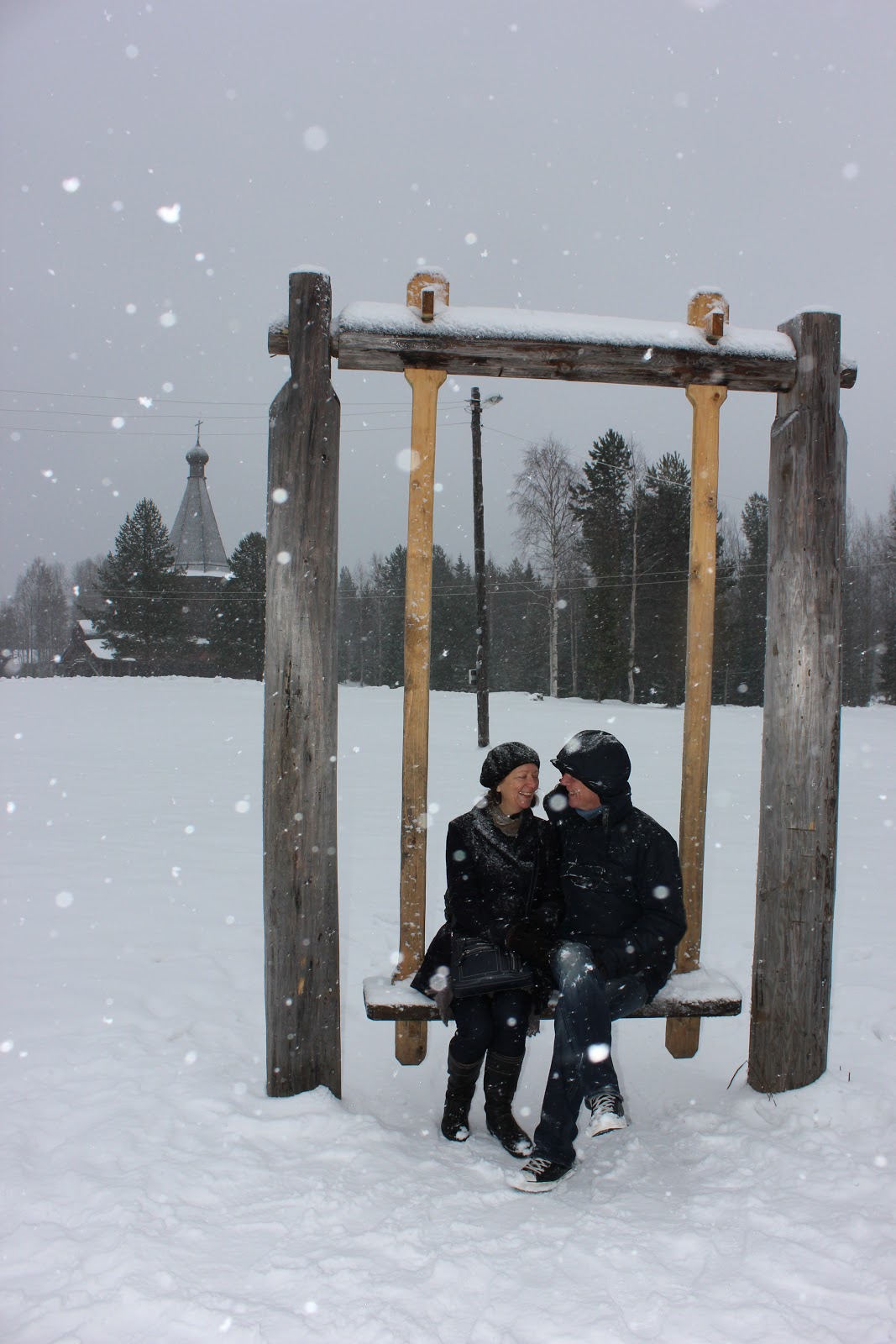
 But next, a moment of light relief : a tall post stands before us which carrries four canvas loops which hang from its top. It is a kind of maypole swing. We each get in our noose and laugh our heads off as we swing dangerously in out and arrowly avoiding concussion on the post itself.

Then Elena spots a warning sign on the post. A list of don’ts began with Don’t eat food and drink whilst swinging, don’t throw away anything whilst swinging, don’t carry large sharp objects, don’t bring any animals or hand luggage with you, don’t use whilst under the influence of drink or drugs, or during wind speeds in excess of ten metres per second - finally, an injunction to ‘ use common sense at all times and a reminder that the museum cannot be held responsible for any accidents if any of these rules are broken.

We read these after we had broken nearly all of them and yet survived!

As we leave the site of all this snow surrounded history, perfectly and rightly preserved, we are reminded that it is still a living place - a wedding was underway on he snow, the bride in a snow white dress, the groom with frozen hands, we are invited to share the bread and shout ‘Gorko! Gorko! Gorko!’ ( this means bitter or unpleasant is life before marriage and it is shouted to encourage the kiss which will seal it and make life sweet!) 


Back to Archangel to rest and prepare for our train journey, 3rd class, back to Moscow.

Can I answer any of the questions I raised?
Of course not, there are only ever signs and these can mislead, but the train should help us get to know a few members of the broad masses, today’s proletariat.

 (the photographs were taken by Elena Bruce and Natalia Fridental)

Friday, 31 August 2012


The Battle of Borodino 1812

Victory and Failure

Бородинское поле сражения (Фабер дю-Фор)

The bi-centenial of the Battle of Borodino, which along with the great Patriotic War of 1941 to 1945, is one of the two great features of modern Russia’s historical identity, has prompted an understandable frisson of patriotic pride in the Russian nation.
It is well deserved.
The scholarly research of Dominic Lieven has shown us that Russia’s over- arching aim in chasing Napoleon all the way back to Paris was to establish peace in Europe. Alexander knew that as long as Napoleon was free, Europe was under permanent threat. In this, Castlereagh, the British Foreign Secretary, normally takes all the credit. But then, western scholars have a long tradition of ignoring the facts of Russia’s role in obtaining and maintaining the peace of Europe.
Witness the extraordinary ignorance among westerners of the unimaginable numbers of Russian losses in the Second World War, or the contribution of Zhukov to the defeat of the Nazi scourge.
Yes, most certainly, as Russia was the overwhelming force behind the defeat of the Nazi tyranny, so she was in the defeat of the Napoleonic one.
Be proud, Russia, of your past, of the people who lived where you live today, and who spoke your language. (And some French and German, but nations then were new and uncertain forms.)
When the Russian army marched across Europe to Paris in 1813 and 1814, it was hailed in many places as an army of liberation, releasing people from the exactions of Napoleon, an end to constant war and the restoration of trade and prosperity.
Be proud of this and be happy that Dominic Lieven, himself an American, also destroys the somewhat patronising argument of many western scholars that it was Bonaparte’s miscalculations and the unusual weather that were decisive.
Neither was it, he shows, as earlier scholars such as the British military historian JFC Fuller have maintained, and even Tolstoy, only a matter of the raw spirit and courage of Russian troops inspiring the nations under the French heel to rise up against their oppressors.
Nor was it mostly that the flames of Moscow’s fires spat the sparks that set the flames of nationalism under Napoleon’s combustible empire and burnt it to the ground.
No, these may have played a part in the drama, but they were not the leading player.
Centre stage was the Tsarist state itself, with Alexander and his aristocratic circle in full support.
The Tsar possessed strategic understanding, and the resources of the nation were husbanded and marshalled according to this understanding : military flair: flexible and fast moving cavalry; logistics; intelligence and diplomatic competence, all combined to produce the unconditional surrender of the egotistical maniac that had stolen his country from the revolution of 1789 – Bonaparte, the arch opportunist, the archetype of a tyrant intoxicated by power, a man who bragged that he cared not a jot for the lives of a million men.
This analysis did not find favour with the Bolshevik regime, of course. The special spirit and courage of the proletariat and peasantry do not figure in it sufficiently as the crucial elements.
But as Lieven points out, there are only two memoirs from the ordinary soldiers of the Campaign of 1812 – 1814. We really have no idea of the spirit or suffering of the masses of Russian or other troops. This was largely, for most of the Russian peasantry that made up the cannon fodder at the Tsar’s disposal, a silent sacrifice as far as posterity was concerned.
This reminder of the unknown soldiers of world history prompts me though, to ask you, proud Russians, to moderate the celebrations a little, and leave a little room for humble reflection.
Wilfred Owen, the great English poet of The First World War, reminds the world that cares to read him that the dead of the battlefield are never asked for their opinion on whether the victory was worthwhile.

…..I am the enemy you killed, my friend.
I knew you in this dark: for so you frowned
Yesterday through me as you jabbed and killed.
I parried;but my hands were loath and cold.
Let us sleep now……

These are the final four lines from ‘Strange Meeting’ found in Owen’s papers after his death on the Western Front.
The poem contains the lines which have come to encapsulate another view of war :

…..For of my glee might many men have laughed,
And of my weeping something had been left,
Which must die now. I mean the truth untold,
The pity of war, the pity war distilled.

Surely, as we celebrate a victory in a battle that had to be fought, a battle of national survival, we must remember and reflect on this : that the whole truth is rarely told of war.
Nations co – opt victory for them selves and ignore defeat. We British have Waterloo Station not Dunkirk Station. Blucher, the Prussian, saved the day for Wellington, but he rarely gets a thank you in England. The French have Austerlitz but not Leipzig.
The amnesia extends from the bottom – the lost lives that never speak, to the top – the sublime truth that in strategy, every battle is at least a partial defeat.
The aim of grand strategy is not to destroy men but to destroy or eliminate the will to fight.
If your enemy attacks, you have failed before you begin.
The cost of war is always immense, and the price paid is always incalculable.
Not, perhaps, entirely incalculable – buildings and factories can be replaced, Hiroshima and Nagasaki are resplendent again, and we can use the art of accountancy to calculate the cost.
But how do we put a price on the truth untold?
When the dogs of war are let slip, as they always are, over and over again, we are every time failing to solve the greatest problem faced by the human species, the one problem that science, otherwise our one great hope, can never solve, and religion, the hope of billions, has only ever avoided – the problem of human violence.
Every single battle ever fought, and every single battle that will be fought, will in this way be a failure.
For every battle won hides and buries some of the truth.
And every battle won lodges the seeds of the next in the hearts of men and women.
And somewhere, quietly working in a laboratory, men and women are working on the next generation of deadly weaponry.
Let us remember this alongside our pride in battles won.
Enjoy the day, dear Russian friends, but please do remember that while Borodino was a victory, like all battles, it was also a failure.
The Statesmen of history have fought, won and lost a lot of wars. Few of them have fought war itself.