Showing posts with label Moscow Metro. Show all posts

Monday, 21 January 2013

Strange connections : Gerard Depardieu, tax, patriotism and Mayakovsky


Gerard Depardieu is a badly behaved actor.

He has has been convicted of drinking and driving and is alleged to have assaulted somebody that he crashed his scooter into.

On an aeroplane, he appalled his fellow travellers by urinating in the aisle.

He is incontinent generally, it would seem, being unable to control his appetites.

Our writing this will not offend him in the slightest - he is the sort of person who doesn’t care what anyone thinks, which is probably just as well.

Now we don’t really care much about him either, but we were struck by the claim that M. Depardieu made, during his dispute with his own government over taxation, that he is a creative person.
And since he is now a Russian citizen, and has been welcomed personally, and endorsed as a model citizen, by President Putin, we thought it might be interesting to reflect on whether M. Depardieu’s legacy in Russia will match that of the great Russian poet Mayakovsky (1893 - 1930) - a man who really was creative.

Why make such a comparison at all?

Well, M. Depardiue deserves to be brought down a peg or two, so comparing his claim to creativity to someone whose claim is not in doubt seems to be a good place to start.
Secondly, M.Depardieu’s publicists call him ‘larger than life’ (a common euphemism for overweight actors) so perhaps the comparison will make him look like a pygmy, which can only be sobering for him, which in turn can only be good for his health.
Thirdly, Depardieu claims now to be a Russian patriot, and to regard the Russian people as beautiful and creative, although this compliment does not extend to the opposition, whom he regards as unpatriotic.

‘Judge not, that ye be not judged, for measure for measure shall ye be judged the same....’

I hope these reasons suffice, but there is a fourth, which is simply that we love Mayakovsky’s poetry and admire the way he lived.

M. Depardieu, his art or life, we do not.


M.Depardieu, like a lot of movie actors, just plays himself. And like a lot of movie actors who just play themselves, he has eventually become a parody of himself.

Mayakovsky, on the contrary, was a creative genius, who could write lines like this, which even in translation stir the soul :

You can forget
              when
              and where
you stuffed
               your craw
               and your belly,
                               but
the land
    you hungered with
        you can never
as long as you live and breathe
                     forget!

Mayakovsky knew something about patriotism that Depardieu will never learn.
Although the poet of the Bolsheviks, Mayakovsky, who worked hard for the revolution, and spent time in prison for his work for it before the revolution, became disillusioned with the turn towards authoritarianism and began to write satirically of the regime - a risky business.
He didn’t, though, run away to avoid paying his taxes, despite the fact that he was allowed to travel and did so widely.
He also had a strong, deep and resonant voice, strangely reminiscent of Tennyson reading The Charge of The Light Brigade - both great men, a generation and a continent apart, but conjoined by the art of poetry.


Mayakovsky has been memorialised by Russia in many ways - in Moscow, he has a museum and a theatre named after him and a Metro station dedicated to him.
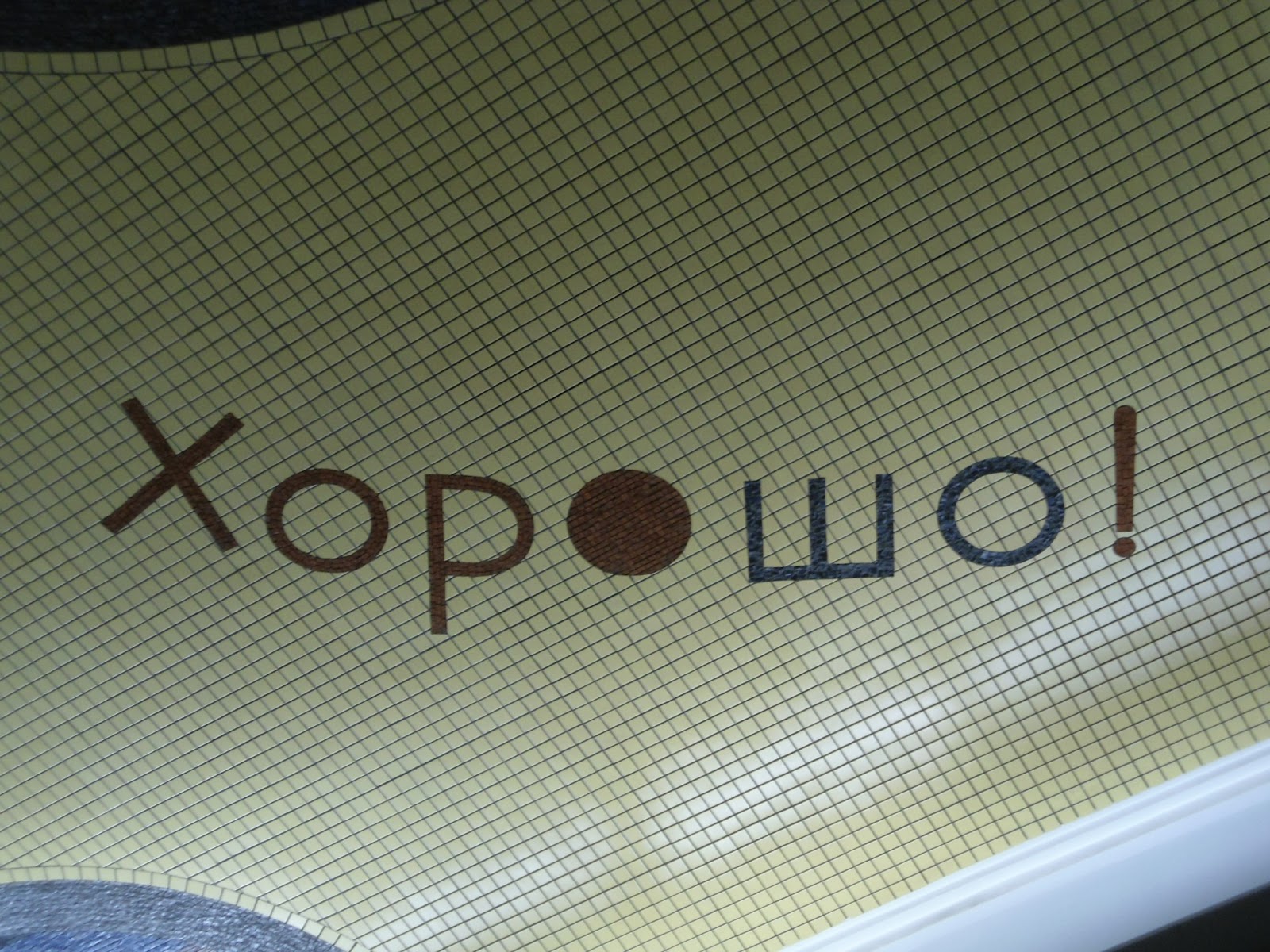
This station is magnificent, a palatial corridor runs between the main platforms and the ceilings are decorated by mosaic renditions, in the style of orthodoxy itself, of bolshevik iconography.
The entrance vestibule is equally splendid, a gently rising and arching dome decorated with lines and words from his most famous poems.


Here is a question for the Russian Government of today : imagine that you need to increase the level of taxation from its current level of 13% to cover some emergency - perhaps another currency crisis, or the return of the oil price to $25 a barrel. Do you then imagine that M. Depardieu will still be a Russian patriot and stick around to share the pain?

He hasn’t got the bladder for it.

The only memorial he is likely to have erected is a temporary public lavatory.

Last year, Russians took $560 billion out of the country - it's called Capital Flight, and it's serious.

What do they know that M. Depardieu does not?

Oliver Wendell-Holmes, the great American jurist, said ' Tax is the price you pay for civilisation'

Russia is almost alone in having a flat rate of tax which is not only very low but does not graduate at all as income increases.

This is a right wing libertarian American's fantasy. Why aren't they all here.

They too, must know something that M.Depardieu does not.


Me at Mayakovsky Metro Station impersonating the Wi-fi and Police sign and generally avoiding tax in the United Kingdom by being here and unemployed!


Unless otherwise stated all photographs by Elena Bruce

Sunday, 2 December 2012

Theatre, improvisation and Superstition all in a Moscow Night


At the Metro station Ploshad Revolutsy we were staggered to find, as we left the carriage, an array of statuary on every available corner of the platform and in every available recess from its main thoroughfare, depicting the revolutionary proletariat working, resting and multiplying whilst building the socialist paradise on earth.


The figures were carved from bronze, and each carried a beatific and hagiographic expression as he, she or their dog stared with glistening and wet eyes towards the collectively built future. Their labour was hard - no matter; the future would reward them and each gave according to their ability and each received according to their needs.
Each being frozen in an attitude of sublime satisfaction or confident longing, I could only think of Keats, but sorry John, I've tampered with two lines from your brilliant ' Ode on a Grecian Urn':

Thou still unravished bride of quietness!
Thou foster child of silence and slow time
Soviet sculptor, who canst thus express
A labouring tale more sweetly than our rhyme!


The station was busy, people surged back and forth from the central corridor to the platforms on each side. It seemed even more crowded because there were so many of these frozen figures from the past, busy building the future or resting from it and raising the next generation for whom the state will have withered away and the only remaining task that of ‘ the administration of things’.
Stopping to photograph a handsome worker with his dog, I found myself, whilst posing beside it, in the way of people who wanted to pat it.


 But no, it wasn’t a pat, it was a rub, and it was its nose which they rubbed. Every other person rubbed the happy dog’s nose as they passed.
Its nose shone with a century of affectionate rubbing. Yes, despite the best efforts of the Bolsheviks to suppress religion and superstition, a custom had emerged from the impenetrable mystery of the human soul, of rubbing a bronze dog’s nose for good luck.


How happy this charming irrationality made us feel. We rubbed its nose too, and we had some good luck as a result - there is no smoke without fire after all and which of us knowingly walks under a ladder if we can avoid it?


Though cowards flinch and traitors snigger,
We cannot help but stand and stare
Before each touching, crouching figure
Deep down Revolution Square.
Who could not love such noble creatures?
Their kindly but heroic features
Suggest a race of Myrmidons,
The rational Future cast in bronze.
For luck - or else to ward off failure -
Commuters rub the guard-dog's nose,
Till you could even say it glows;
They also stroked its genitalia
But higher organs disapproved 
And now he's has his balls removed.

(by Andy Croft  'The Dog's Bollocks' from "Three Men on Metro", 2009)


We were transfixed by the range of statuary in the station - young mothers with children on their laps, young fathers helping young sons to play with model aircraft. It was Raphael like in its attempt to show the divine at work in the human vessel, the divine light of socialist love, finally revealed and made incarnate here on earth.

But it was time to move on - we were due at the theatre to watch an improv actor perform a piece at a small theatre on the Arbat street.
Of course, there was no signage and the number of the block was not visible - there was 45 and there was 49, but we needed 47 and it was not there.
We asked in the big theatre opposite where it should have been.
It’s opposite, she said.
It’s not, said Elena.
It is, go away, she said.
It was opposite, but around the corner. How were we to know?

The theatre was packed with people from 5 to 60 years old. Most seemed to be young teenagers, the girls painfully self-conscious, looking for looks, the boys equally so but hiding it, and looking to give the looks and hold them, but the girls looked away quickly.
The remainder must have been parents, but there were some student age kids too and a few sad stragglers like us, friends of friends of the performer.
It reminded me of a Niel Young concert from the 70’s.
A man around 30 sat on the stage, strumming his acoustic guitar.
The girl next to me - not Elena - was singing the song he was strumming.
It was a Happening!
He eventually introduced himself, his back-pack and his boots.
He had hitch-hiked to Moscow from small town Mariinsk in Siberia and he was going to introduce us to the gallery of characters who had been kind enough to give him a lift.
I hope none of them were in the audience, or it will take him a long time to get home.
No, many of the portraits were affectionate, but they mostly came from the strange position that I remember I had when, many years ago, I hitch-hiked my way across the USA - the position of moral superiority to the car-owning and square bourgeoise who had given you a lift.
It was, though, a happy atmosphere, pleasant, mild and congenial, and a lot of laughter and cheerfulness was created by the itinerant artist and his tales of the road. 


It is refreshing here the way that so many genres and periods seem able to co-exist without the slightest self-consciousness or snobbery.
London or New York have splintered their cultural life into thousands of shards of sub-cultural niches, but they are generally very intense, almost Masonic, and the correct clothes must be worn and verbs and nouns employed.
Here it’s all jumbled up like a car-boot sale and it’s very relaxed as a result and usually a bargain too. And mum and Dad come too.
Now that is weird.

PS. By the way, Elena said me that the actor's name  was Petr Zubarev and the performance was in the Dom Aktera at Arbat street. 


Unless otherwise stated all photographs by Elena Bruce

Tuesday, 27 November 2012

Russian hospitality - ritual,vodka,dinner and shoe manners


The great Billie Holiday once said, ‘ I don’t like going round to other folks’ houses - the drinks don’t come up fast enough and you can’t leave when you want to.’

She would have been fine about accepting hospitality in Russia because the drinks come up very fast indeed - in fact, it is a social offence for the vodka glass of one’s guest to be empty.

Let me set the scene : we were met at the Metro station Rimskaya, which is typically individualistic and spectacular but also atypically whimsical in design: at the end of one platform  are a pair of Roman columns and clambering across one of these which lies prone are Romulus and Remus. I can be seen here in a kind of Jimmy Saville moment,patting one of the founding babies of Rome’s bottoms- what was I thinking of?


As we emerged from the subterranean depths, propelled by an escalator half a mile long, we were astonished by the sight of an enormous giant crane of an office block - like an inverted L-  which rose up incongruously from the centre of the large pedestrian square we found ourselves lost on - it stood at a thirty degee angle to an adjacent tower over which the the horizontal section at the top, the section like a crane - reached out over its neighbour. But it wasn’t a crane, this gantry section was offices, and how the mechanics of the design prevented its collapse I cannot imagine. Elena trained as a civil engineer and she could not either. 
        

But boy was it ugly, as ugly as Socrates in that there must have been much intelligence buried away in its design.

There was no Soviet era excuse either - this is a post-modern monstrosity, brand new and still under construction. The architect must be angry inside,still seeking revenge against an uncaring world, the firm that commissioned the architect must be over indulgent or deranged, the citizens of the area must be appalled. If architecture is frozen music, this is Harrison Birtwhistle - he of the crash bang wallop, silence then a long farting sound school of contemporary music - with added flatulence and dyspepsia.

Have a look for yourselves here.
This bleak house is on a thoroughfare close to central Moscow!

Russians do seem to be capable of creating large tracts of bleak and intimidating space in Moscow. Buildings bigger than small countries run for miles along twelve lanes of motorways that gouge out the heart of the city. These edifi give the impression that Stalin personally oversaw each design and then had the architect shot for not understanding what was needed, which was to make the people feel his power as they passed the building.

Our host arrived to rescue us. He led us through the usual urban dystopia of vast blocks of flats, each as big as Bedford. From the air, or on google maps, Moscow looks like a miscellany of hoops, loops, rectangles and squares which are delineated by the six lane wide main thoroughfares and within each of these are randomly arrayed dominoes which are the tower blocks of flats as big as towns. Everywhere is miles away from everywhere. As America makes England look like Toytown, Moscow dwarfs anywhere I have seen in the USA and it makes London look like the land of Tom Thumb.

Up on the 11th floor of our host’s city in the sky block, I was courteously invited in and introduced to Victor’s wife, Luba.

Shoes are always removed immediately and slippers are offered to guests.

The view from each window is one of millions of other skydwellers staring back at one. Their skydwellings stride out like Potsdam Giants, out into the night and across the endless steppes of Russia.

On the table was spread a kind of substantial tapas of at least twenty different dishes - salted cabbage, gherkins, salted tomatoes, olives, potatoes, salads, chicken, pickled mushrooms, pasta packets of mince....and beside me, and each of us, a vodka glass.

It is important to drink vodka down in one. And eat.

The host is obliged to refill your glass immediately.

And I am obliged to eat.

And drink my vodka down in one.

And eat.

Our host was not insensitive, but a feast had been laid out, a fatted calf had been killed.

We must eat, and the salt made me thirsty, so although it is not compulsory to drink the compulsorily filled vodka glass, I did, and it was filled again, and I ate, and was thirsty again.....

The feast of Balshazzar appeared as a blurred memory trace in what was left of my operating mind.

I saw the prophetic words write themselves upon the wall opposite ; ‘ Thou hast been weighed in the balance, and found wanting!

If I had been weighed the scale would have shown me to have put on a few kilos.

But I interpreted these immortal words as a challenge, and did not decline as more food was offered.

The vodka was soaked up by the food, which was delicious, so despite the fact that we had emptied a large bottle between four of us, we were mellow rather than drunk.

It is bad form in Russia to drink on an empty stomach and to lose control of one’s tongue.

The Russians like conversation as well as chatter and gossip, and drunken blathering is an affront to one’s host.

I realise that it probably is bad form everywhere, but somehow drunkenness has become more acceptable in London in polite circles, and somehow, although there is no shortage of drunkenness in Russia or anywhere, it just isn’t here.

Our hosts had loved their time in London.

A bottle of Bushmills Irish whiskey was produced, but we were all so replete that it couldn’t penetrate the dense lining that our stomache’s enjoyed and we remained happily mellow.

It was time, after a few spoonfuls of jam, made, like all the rest of the food, from produce grown in the garden of their dacha, to leave.

After much warm shaking of hands and uninhibited hugging, we were out into the vast forest of skytowns and down into the roaring rushing metro and home.

A wonderful evening.


 Unless otherwise stated all photographs by Elena Bruce