Sunday, 24 November 2013

Luxury and lunch at Muscat's most magnificent ministry....well, hotel, palace and temple

Our taxi slowed respectfully as it passed though the elegant entrance of the Al Bustan Palace Hotel.

The lawns rolled and stretched away on either side and the palm trees bowed in welcome as we slowed before the magnificent edifice before us - The Al Bustan Palace Hotel.


It was built as a palace and it remains a palace, the hotel having merely moved quietly and discretely into the vast and airy canopy and its adjacent wings without disturbing its serene cloisters and princely passages.

Inside, we almost genuflect - it is a temple too, a vast dome soars up and shafts of divine light slice through the fragranced atmosphere.

If you've been having a tough time of it, and you need a break, this is the place to come. The staff are razor sharp on every doubt and potential need, solicitous without being in the slightest bit oleaginous or Uriah Heep.


We were welcomed by Mara Isono, EAM Secretary, who introduced us immediately to Mohammed, sitting with his friends who immediately become our friends, and served us Arabian coffee and dates.


We were overawed by the infinite sense of indulgence promised in every stone and every friendly glance.


Mara led us into the gardens, which must have been sculpted by the same landscape gardeners responsible for the Elysian Fields and The Garden of Eden, with maybe a contribution from the Augustus golf course in Atlanta.
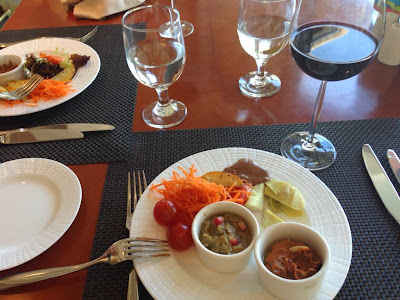

Lunch was a buffet, but that term is inadaquate to the task of conveying the exquisite range of texture and flavour that we were treated to and the genuine attentiveness of our waiter.

 The great philosopher Wittgenstein said, 'Whereoff you cannot speak, thereoff you must remain silent'.

He also said that somethings cannot be said, they can only be shown.

Until today, I didn't really know what he meant by either of these statements.

I do now.

Saturday, 23 November 2013

By bus to Dubai from Muscat, the world's tallest building and biggest shopping mall loom up from the dunes..........


The bus from Muscat is a bone shaker from the 1970's - we were travelling with the people, well, a couple of Indians and an Omani woman or two. The conductor was exhausted by his labours of checking the passengers' tickets and soon fell asleep, abandoning his main job of keeping the driver awake with conversation.


The Omani desert and scrubscape is littered with half started motorway projects and half finished houses.


An embryonic freeway flyover stands starkly over an intersection, its angry steel support joints snarling at the indignity of being left naked and useless, with no sign of its connecting companions.

Oman aims to tarmac the desert and recreate Los Angeles' in the Arabian Peninsular. They will get there in the end as they seem to be as determined as los Angeleans to create a car based world of lonely isolation in which every human feeling is mediated on four wheels and all the public spaces are roads.
We fall asleep as the bus grinds and growls forward on the eight hour trip.


When we awake, we are in Dallas, Texas, or Houston, but as our eyes find their focus we realise our mistake - an easy one to make - we are in Dubai, which is Dallas or Houston or any number of US cities, transplanted to these Arabian sands. Maybe it's all the oil, but the Emir must be suffering from the same sort of affliction that has blighted America - Giantism, or mine is bigger than yours syndrome.
But we must concede - in its gleaming glass erectile style, it has an eirie beauty and efficiency that is a pleasure to experience.
The taxi's arrive as swiftly as yellow cabs in New York City, but they are cleaner and the drivers' are polite.


We arrive at the world's biggest shopping mall and, despite ourselves, we are seduced immediately, even buying a jumper for Elena, and a bag of souvenirs in a gift shop.


The fountain display comes up like a ballet and we eat a delicious spaghetti pesto and miso soup in a strange hybrid restaurant of Japanese and Italian food.


From the top of the world's tallest building, the Burj Khalifa, we are humbled by the engineering involved and the almost impious achievement of this recreation of the west as an oasis for global trade in the middle east. This is globalism, and it's for making money. It represents an Arabian vision and was realised by a global collaboration, which itself must be a hopeful sign.

Here comes everyone, you might think, and they are all well dressed and well off. But globalism floats on a sea of human struggle as men and women are separated from families by the necessity to find work thousands of miles away from home. Pockets of unemployment and poverty drive millions across the skies to staff the service army recruited by Dubai and other pockets of posperity in the Middle East and around the world.


Our waiter Leo Bonillo is a charming young man from Manilla, where there is no work. His children are at home with his mother. And this story can be found over and over again, in Shanghai or Dubai, London or Moscow, New York or Mumbai. If home is where the heart is, there is a lot of heartache in Dubai.


Wednesday, 13 November 2013

The Red Arrows over the hot blue skies of Muscat, musings on Machiavelli and The Sultan, happiness and where it comes from....


Elena and I take a taxi from our hosts' suburban Muscat home to The Intercontinental Hotel, from where we will crane our necks up towards the dizzying blue above to catch sight of The Red Arrows jets beginning their precipitous formation dives down to earth, or just above it.


On the journey, there are Omani flags flying from the cars which also proudly display portraits of the handsome Sultan, his grey tinged beard (of formal cut) symbolising both vigour and the wisdom of age.
In the backs of cars, children smile and wave at us. Why?
They don't in London. And we would not dare to smile and wave back in London.


We take a photograph of two young men walking on the side of the road. They smile at us and wave. Why?
We have travelled widely in this whole wide world, but rarely have we encountered so much smiling. Why?
Perhaps they are pretending to be happy but we doubt that. It's not that they want anything, since we are not offering anything.

And then above us, as the red jets roar and scream around the submissive skies, we find the answer.


Love. All you need is love, as Britain's greatest musical export sang.
But this can only be one piece of the answer. If it's true that Omani's have more than their fair share of the elusive elixir of a happy life, where do they get it from?
Here is our theory: We must learn how to love from our Mother's milk and every moment of infancy upwards, by example and by precept, every single day. A long time ago, in the searing heat of the Omani desert, a tribal leader realised that the only way to survive in the barren and lifeless terrain around was to harness all the life force of all the people, and the strongest of these was love.
And so it began.

Niccolo Machiavelli, when he wrote his handbook for Princes in 1506, advised them that it is better to be feared than loved - if you cannot be both. Now nobody would pretend that Oman does not have problems and some consequential unhappiness. This is the real world, despite the almost unreal sea of good nature all around, and men still steal, cheat and thieve and the life of man would be 'solitary, poor, nasty, brutish and short' without the potential use of force. We believe The Sultan knows that he needs be feared and loved because the wisdom of the Sultan is not in doubt. He was very impressed as a young man by British freedoms and democracy but he wisely observed that they had been achieved over an 800 year period of evolution and struggle, including a violent revolution and a military dictatorship. Armed with this self observed insight, he began his careful work of introducing Oman to the responsiblity of freedom. We wish him well on his anniversary, and recommend Machiavelli to him. It's a dangerous world.

Monday, 11 November 2013

A modern medieval paradise of empty beaches and different degrees of freedom - Oman


Here in Oman, the laws of economics have been refuted convincingly. We observed it ourselves. Walking in the searing heat along a wide boulevard, we flagged down a taxi. We had no idea where we were or how to describe where we were going. The driver was patient and kindly. He slowed at every junction and landmark that we thought we recognised. Eventually, after about fifteen minutes of driving around in circles, we realised where we were and asked to be dropped off.
How much is that please? I asked.
No, I cannot charge you, he replied, it is my pleasure to help you, you are a guest in my country.
I could not persuade him otherwise.

According to all the laws of economics this should not have happened. Adam Smith said that it is not to the kindness of the baker or candlestick maker that we should look for our candlesticks and bread, but to their looking after their self interest.
What are we to make of a taxi driver who displays more kindness than self interest?
Perhaps culture is more important than economists have noticed.


And here the culture must have been at least partly formed by emptiness, the emptiness of everywhere. Vast stretches of beach, beautiful and deserted, stretch for miles and fringe the city of Muscat with a brocade of yellow sand and blue green sparkling sea. Beyond Muscat, empty square miles of flat scrub and desert with an occasional eruption of bright green palm trees and isolated villages. Behind this, a lunar landscape of slate coloured mountain, sharp and jagged, implacable and barely penetrable.
Of course, there are people, men in immaculate white and women in solid black, Indian migrants in clothes of many colours and westerners in their uniforms, but there is empty space between them all, even in the most populated of places. The space between them is respect, a different kind of mutual respect than we see in London because here it feels more gracious, polite and friendly.
Perhaps space itself is a form of prosperity. And prosperity provides the wherewithal of kindness, though not the motivation.


Elena and I have been spending our time on a deserted beach in Muscat. It's not completely empty. There are fishermen who wave at us and ask us how we are. There are occasionally young lads who swim in the mostly empty sea as we do, or cartwheel and cavort on the beach. And there are cars and trucks that drive along the beach, to our surprise, but most of them belong to the fishermen who use them to tow their boats up the beach.


Staring at the men pulling in their nets I could not but help thinking of Jesus approaching the disciples as they too pulled in their nets. Come with me, he said, and I shall make you fishers of men.
Perhaps, perhaps, the message of gentle Jesus, meek and mild, not he that came with a sword, but he that turned the other cheek, only really got through here in Muscat, where today the muezzin call all to prayer five times a day.
The citizens of Oman live with what we might think of as restrictions - drink and dress, for example, but they also live with a sort of freedom that we in the west have lost to the reduction of everything to impulse and instant gratification.
 How much can I respect you if I must have what I want now?


Saturday, 26 October 2013

Handel and Mozart in London at St Martin in the Fields and George Osborne tells us to stop thinking about China as a sweatshop...

The Meteorological Office are predicting a terrible storm on Monday, and this makes us think that the gusting wind and scurrying litter are harbingers of worse to come. Dark and lumpy islands on an inky sea scud across the great canopy above London. We expect the weird sisters to jump out in front of us, gibbering and screeching about the ingredients of chaos to come.

We thank the sun, sea and skies for St Martin in the Fields, whose glorious baroque stone shines bright against all this gloom as we approach it for the concert to be given by the London Concertante: Handel, Mozart and Vivaldi, plus some contemporary composers.


As we enter the elegant, spacious and gracious commode of the church, I find the speech that George Osborne, the Chancellor of the Exchequer and number two to the Prime Minister made about China niggling away at me. He said we must stop thinking of China as a sweatshop and think of it as a high tech trading partner.

The trouble is China is much worse than a sweatshop - it's a forced labour camp. In fact, China runs the biggest concentration camp system the world has ever seen, even bigger than Stalin's Gulag. Chinese companies have front companies that they show to foreign activists and investors, but behind these are political and criminal prisoners working for nothing in brutal and murderous conditions. A leopard doesn't change its spots that quickly, and China's tradition of running the country as a vast prison camp has not changed much. If you don't believe me, check out the work of Harry Wu, who after 19 years in the camps has dedicated his life to exposing the truth. It's hard work for him because it's easier for all of us to dismiss him as bitter, twisted and wrong. But the evidence is irrefutable.
Should we care?
I think so, but now the sinuous and seductive violins are stroking my troubled soul, and I hold Elena's hand and think how lucky I am..........around us is a packed church of listeners all entranced by the music. Some of them look Chinese. Would they welcome my thoughts.......would they share them?

Sometimes we just get the blues, because there are no easy answers but we know something must be done. When that happens, listening to the blues works pretty well. Try this, from Gary Clark Jr....


Friday, 25 October 2013

London tradition on the streets, we liberate Ronnie Scott's for the people...

The charming sound - clip clop, clip clop, of horseshoes on tarmac.


The bright and cheerful red and gold uniforms of the carriage drivers, the two 18th century carriages themselves, one open, the other covered. It could only be London. The Queen has sent a couple of carriages round to Queens Gate SW1 to pick up the new Iraqi ambassador to Her Majesty's Government. She wants to say hello. What a gracious way of facilitating a business meeting. It saves on petrol and is good for the environment. And it probably is very impressive, a reminder, perhaps, that Britain's now tired and corrupt representative democracy has been evolving slowly since roughly 1215, when the big Barons' got King John to agree to trial by Jury and an embryonic parliament. They achieved this by taking to arms and capturing London from him. In other words, by the threat of violence. By the way, here are the two great clauses 39 and 40 of The Magna Carta which he was forced to sign. It is the most important document in English and world history and it shaped the future of freedom in Britain and around the world :

No free man shall be seized, imprisoned, dispossessed, outlawed, exiled or ruined in any way, nor shall we attack him or send men to attack him, except by the lawful judgement of his peers and the law of the land.

To no one will we sell, to no one will we deny or delay right of justice.

 There you go - here are the origins of consent to taxation, parliament, due process and the rule of law.

But it took a lot of trouble and strife to get from there to 1928 when Britain finally became a full democracy and women got the vote on an equal basis to men.

History lesson over, we go with my youngest daughter Charlotte to Ronnie Scott's jazz club for the late show. It didn't start until midnight, but man, what a brilliant scene it was, packed with young jazz fans and even a few old timers like me. The lights were low, the vibe was cool, then brisk and driving, the trumpet urgent, plaintive, insistent, indignant, intemperate and insolent, ingenious, then treading soft, calming, pleading........and the pianist, the bassist and the drummer listened to the trumpet and joined the conversation and they all listened to us, the audience, and created the sound and song of the joy of all life...yes, we are here, let's enjoy it because it is exciting and will only happen once!

No more war!

And we liberated this short clip from Ronnie's to encourage you all. Just click on this link below.

click here to see the video


London life: Debate, discussion and misunderstanding

The heavens are caressing London with  golden light and the trees in Hyde Park bring out their golden robes in return.
All is well in this the greatest and freest city on earth!


It is Elena's birthday. To celebrate we go the The Landmark Hotel on the Marylebone Road for afternoon tea: me, Elena, her Mum and one of her sons and his girlfriend. A happy and harmless crew.
The solicitous doorman is kind and considerate as he shows us how to get the wheelchair conveying Elena's Mum into the cafe.
We are seated in the voluptuous setting of the atrium cafe and champagne is served.
Elena's Mum is beaming with happiness, pride and joy.


But alas - it is fearfully expensive. I ask the waiter if we can buy just one afternoon tea and share it. We are not very hungry. The waiter must ask the manager. No, we must buy three. This would amount to £126. Surely, I persist, since the cafe is virtually empty, and we are drinking the champagne (not cheap either - at £76!), you can bend the rule for once. The manager appears and firmly insists that the rule cannot be broached. If we consume less than three afternoon teas, we will have to sit in another part of the hotel. This would mean us reseating Baboushka in her wheelchair and going up to another floor.
We decline, amazed by the lack of initiative allowed The Landmark workforce. I was tempted to ask if I would have to ask the manager if I could use the lavatory.

Still, it was a pleasure only partly spoilt, and we walked across to The Frontline Club in Paddington (The Journalists Club) to listen to a discussion about the future of Russia and the fate of the oligarch Khodorkovsky.

The former British ambassador to Russia Sir Tony Brenton thought that things were getting better and that the rule of law will one day prevail in Russia, whereas it is perhaps a little patchy now.
We should welcome their money, he said, and that will be good for us and for Russia.
Other speakers disagreed. The money is tainted and our taking it discredits us.

Later, we are dining in the restaurant below, discussing this issue.
I take the view that it is a matter of balance, but to illustrate my point, say that we should not have wanted to trade with Hitler's Germany if the conditions were that we were not allowed to trade with Jewish people, or with Stalin's Russia if we were forced to trade with companies that employed Gulag labour.

Suddenly, a woman sitting at the table next to us leaned across.

" I would be very careful if I were you" she said, and continued, " I'm jewish, and I heard what you said"

Now of course, she only heard half of what I had said.

But that's how wars start, isn't it?

Somewhat dismayed, because she persisted in threatening me, we left.

Ah well, nowhere is perfect.